
Yes, Medicare covers hospice care. If you have Part A and meet the conditions, Medicare.gov says you pay nothing for covered hospice services from a Medicare-approved hospice provider. What families often miss is the fine print: which care stops being covered once hospice begins, what small costs remain, and how long the benefit lasts. Hospice through Hahn March's Signal Health Group Franchise network is one way to put this benefit to work, with care aimed at comfort, dignity and quality of life for seniors, veterans, people with disabilities and low-income families.
TL;DR
- Medicare Part A covers hospice if a hospice doctor and your regular doctor certify a life expectancy of 6 months or less and you choose comfort care over curative care.
- There is no deductible. You may owe up to $5 per prescription for pain and symptom drugs and 5% of the Medicare-approved amount for inpatient respite care.
- Room and board in a nursing home or other facility is generally not covered.
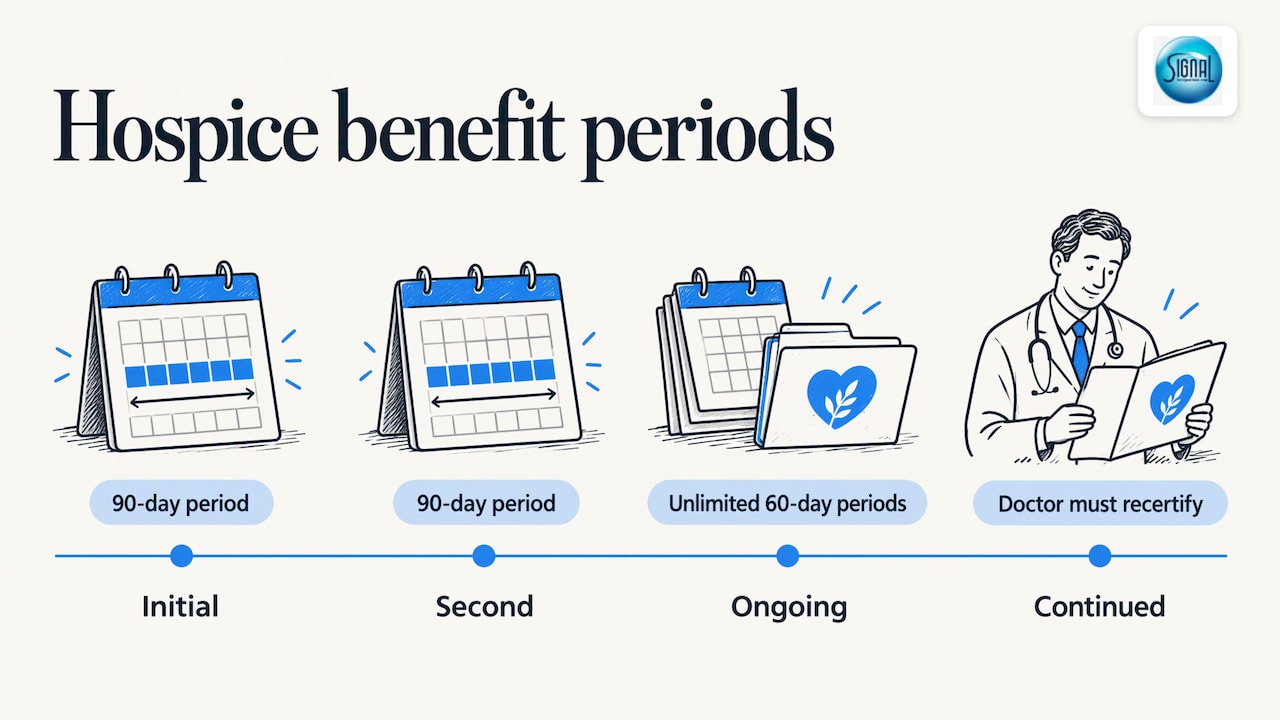
- Hospice is not capped at 6 months: two 90-day periods, then unlimited 60-day periods, as long as the doctor recertifies.
- Care for conditions unrelated to the terminal illness stays covered under Original Medicare.
Table of Contents
- Who qualifies for the Medicare hospice benefit
- What Medicare hospice benefits include
- The four levels of hospice care
- What you may still pay
- What changes in your other coverage once you elect hospice
- How long Medicare pays for hospice at home
- Recent rule changes worth knowing
- Putting the benefit to work with Hahn March
- FAQ
- Sources
Who qualifies for the Medicare hospice benefit
Hospice is a program of comfort care for people near the end of life. Per Medicare.gov, you must have Part A (Hospital Insurance) and meet all three conditions:
- Your hospice doctor and your regular doctor, if you have one, certify that you are terminally ill with a life expectancy of 6 months or less.
- You accept comfort (palliative) care rather than care meant to cure the illness.
- You sign a Hospice Election Statement choosing hospice instead of other Medicare-covered treatment for the terminal illness.
The federal rule says the same: an individual must be entitled to Part A and certified as terminally ill. "Terminally ill" means, per the CMS Medicare Benefit Policy Manual, a prognosis of 6 months or less if the illness runs its normal course. It is a medical estimate, not a guarantee, and hospice is not only for cancer.
Before deciding, you can ask for a one-time consultation with a hospice medical director or hospice doctor about care options and pain and symptom management. According to the CMS hospice benefits booklet, you can have it even if you decide against hospice.
What Medicare hospice benefits include
The benefit is built around the whole person: physical, emotional, social and spiritual needs, with care usually given at home and support for family caregivers, as the CMS booklet describes. MedPAC lists the covered services:
- Skilled nursing
- Drugs and biologics for pain control and symptom management
- Dietary, spiritual and bereavement counseling for the family
- Home health aide and homemaker services
- Physical, occupational and speech therapy
- Short-term inpatient care and inpatient respite care
- Other services needed to manage the terminal illness and related conditions
That mix is why hospice often feels like a team at your door: nurse, aide, counselor and doctor working from one plan of care.
The four levels of hospice care
Medicare pays the hospice a daily rate that depends on the level of care. The CMS manual defines four:
| Level | What it means |
|---|---|
| Routine home care | Regular care wherever you live, usually home |
| Continuous home care | Intensive care during a crisis, mostly nursing, at home |
| General inpatient care | Short-term facility care for pain or symptoms that can't be managed elsewhere |
| Inpatient respite care | Short facility stay, up to five days, to give a caregiver a break |
MedPAC reports that routine home care makes up nearly 99 percent of all hospice days. Continuous home care means eight or more hours a day, with at least half provided by nursing staff.
If you need inpatient hospital care for the terminal illness, the hospice provider must arrange it for the benefit to cover it.
What you may still pay
Medicare does not pay everything, but the costs are small and specific. Per the CMS booklet:
- Deductible: none.
- Premiums: you keep paying your monthly Part A and Part B premiums.
- Prescriptions: a copayment of up to $5 per prescription for outpatient drugs for pain and symptom management.
- Inpatient respite care: 5% of the Medicare-approved amount. If Medicare approves $100 a day, you pay $5 a day.
Room and board is the larger question. Medicare.gov states that you may pay for room and board if you live in a facility such as a nursing home. Hospice does not cover it at home either. Respite stays are limited: the manual says payment stops after five consecutive days at the respite rate, and the patient is liable for room and board from the sixth day.
What changes in your other coverage once you elect hospice
Choosing hospice is a trade. Per Medicare.gov, Medicare won't cover:
- Treatment meant to cure the terminal illness or related conditions, including drugs to cure it
- Care from a hospice provider that the hospice team did not arrange
- Hospital, outpatient or ambulance care for the terminal illness unless the hospice team arranges it
Care for a completely unrelated problem, such as a broken wrist, still falls under Original Medicare with its usual deductible and coinsurance. You may also keep your regular doctor as your attending physician, according to the policy manual, as long as that doctor is not employed by the hospice. Tell every provider you have elected hospice so bills for related care go to the right place.
How long Medicare pays for hospice at home
There is no 6-month cutoff. Federal rules provide an initial 90-day period, a second 90-day period, and an unlimited number of 60-day periods. If you live longer than 6 months, you can keep getting hospice as long as the hospice medical director or another hospice doctor recertifies that you are terminally ill. You do not need to re-choose hospice each time.
You also have the right to change hospice providers once during each benefit period, per Medicare.gov. That matters if the first team is not the right fit for your family.
The "36-month rule" and "80/20 rule" that people search for are not part of the patient-facing hospice benefit described above. What you need to know is the certification and benefit-period structure.
Recent rule changes worth knowing
CMS's FY 2025 final rule, effective October 1, 2024, raised hospice payment rates 2.9 percent and clarified the election statement and who may certify terminal illness. Since May 2024, certifying physicians must be enrolled in or opted out of Medicare for the hospice service to be paid. These are payment details between providers and Medicare; for families the practical point is to choose a Medicare-approved hospice.
Putting the benefit to work with Hahn March
Coverage only helps when a hospice team is in place. Hahn March's Signal Health Group Franchise network offers hospice alongside personal care and home health, with care tailored to seniors, veterans, people with disabilities and low-income families, and a focus on underserved communities. For many families, having personal care and home health available from the same network makes it simpler to plan for the days before and during hospice. Learn more about hospice, home health and personal care services.

If you are a veteran or a family on a tight budget, ask about your eligibility questions up front: your doctor's certification, your Part A status and any other coverage you hold.
FAQ
Does Medicare pay 100% of hospice care?
For covered hospice services from a Medicare-approved provider, you pay nothing. Small costs can apply: up to $5 per prescription for symptom-control drugs, 5% of the approved amount for inpatient respite care, and room and board in a facility.
Does Medicare cover hospice at home?
Yes. Hospice care is typically given at home, and routine home care is the most common level. Medicare does not cover room and board, but you are not charged for it when you remain in your own home.
Can I keep getting hospice after 6 months?
Yes. Benefit periods continue as long as a hospice doctor recertifies that you are terminally ill. After two 90-day periods, Medicare allows an unlimited number of 60-day periods.
Can I leave hospice if I want curative treatment again?
Yes. You can end hospice care at any time and return to your regular Medicare coverage. You also have the right to switch hospice providers once per benefit period.
Sources
- Hospice Care Coverage, Medicare.gov
- 42 CFR Part 418 Subpart B, eCFR
- Medicare Benefit Policy Manual, Chapter 9, CMS
- Medicare Hospice Benefits booklet, CMS
- Hospice Services Payment System, MedPAC
- FY 2025 Hospice Wage Index and Payment Rate Update, Federal Register
- Hospice certifying physician enrollment edits, AAPC