Veterans have several ways to get help at home through the VA: in-home primary care, skilled nursing visits, home health aides, respite for family caregivers, a self-directed budget, and a pension supplement called Aid and Attendance. Most of them require enrollment in VA health care first, a clinical need, and a program that is available where you live. Knowing which benefit pays for what is the hard part, and it decides whether you get help quickly or lose months. At Hahn March, our Signal Health Group Franchise locations deliver personal care, home health and hospice for seniors, veterans, people with disabilities and low-income families, so this guide is written for the families we serve.
TL;DR
- The VA's home and community care sits inside its medical benefits package. You must be enrolled in VA health care, have a clinical need, and the service must be offered near you.
- Aid and Attendance is different: it is a pension supplement paid to eligible pension recipients, not a service the VA arranges.
- Costs depend on service-connected disability status and income. Hospice has no copay in any setting.
- The VA generally does not pay room and board in assisted living.
- Start by enrolling, then ask your VA social worker or geriatrics team for a care assessment.
Table of Contents
- The VA programs that bring care to your home
- Aid and Attendance and Housebound: money, not services
- Who qualifies
- What it costs
- What the VA generally does not pay for
- How to apply, step by step
- Getting care started while benefits are processed
- Looking ahead
- FAQ
- Sources
The VA programs that bring care to your home
The VA's 2026 Federal Benefits guide describes a range of home and community services, each with its own admission and eligibility criteria. Think of them as a ladder, from medical care at home to help with daily tasks.
Home Based Primary Care
Home Based Primary Care is primary care delivered at home by a physician, nurse practitioner or physician assistant. A team adds care management, social work, rehabilitation, psychology, nutrition and pharmacy. It suits veterans with complex conditions for whom getting to a VA clinic is a struggle.
Skilled home health care
Skilled home health covers nursing, physical, occupational and speech therapy, and social work. VHA Notice 2024-01 also lists assessment, treatment planning, monitoring, education and follow-up as part of it. Unlike Medicare, the VA's clinical eligibility for skilled home health does not require homebound status or a face-to-face visit requirement.
Homemaker and Home Health Aide services
This is the benefit most families mean when they search for help with daily life. Trained aides help with eating, dressing, grooming, bathing, toileting, transfers and grocery shopping. They are not nurses and work under a registered nurse's supervision. Enrolled veterans of any age may qualify if they meet clinical criteria and the service is available.

Respite and adult day health care
Respite gives the family caregiver a break and keeps the veteran safe while they are away. Adult day health care offers a daytime setting with health and social support. If you are the one providing most of the care, our guide to dementia respite care walks through options, costs and how to start.
Veteran Directed Care
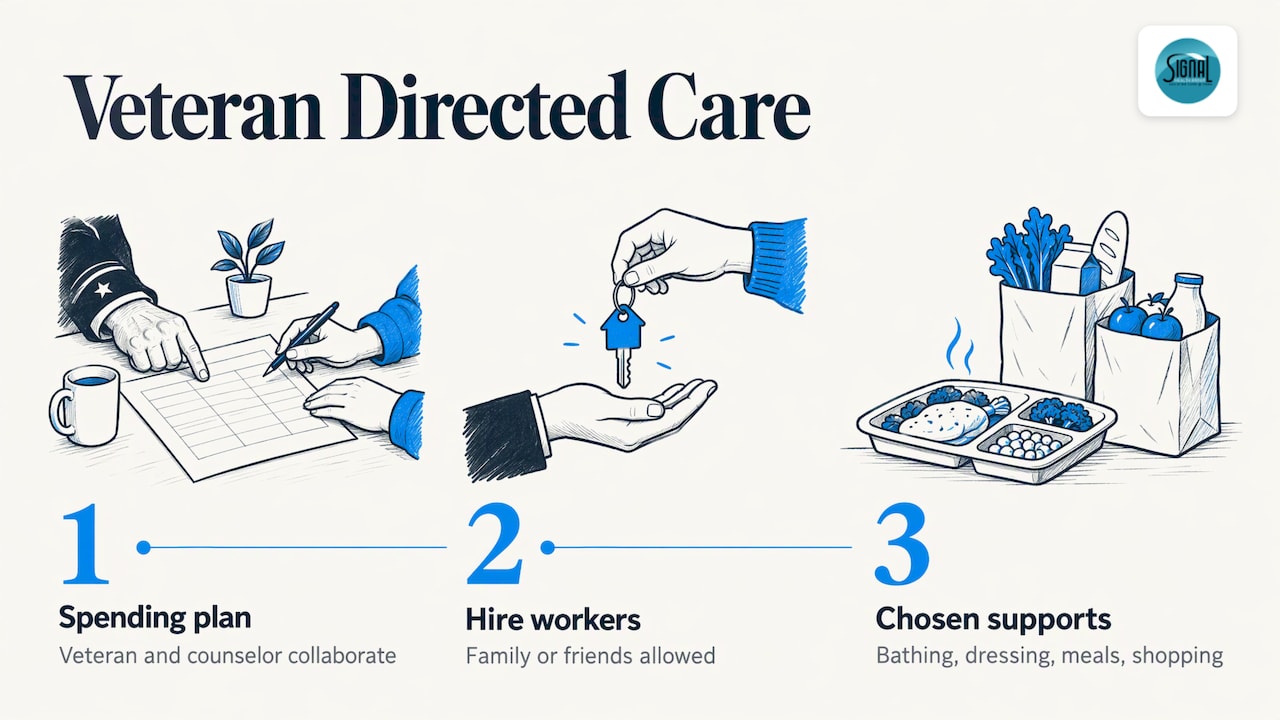
In Veteran Directed Care, the veteran or a representative works with a counselor to build a spending plan and hire workers. Needs such as bathing, dressing, meals, moving around and grocery shopping can be met this way. VHA Notice 2024-01 notes that veterans can hire family or friends. Control over who comes and when is the program's central feature.
Hospice and palliative care
When the goal shifts to comfort at the end of life, the VA offers hospice and palliative care. Per the VA, hospice has no copay in any setting. Veterans who also have Medicare can read how Medicare hospice coverage works under Part A.
Aid and Attendance and Housebound: money, not services
Aid and Attendance and Housebound are increases to a VA pension. They do not send an aide to your door. They give eligible pension recipients extra monthly income that can help pay for care. The VA says a veteran cannot receive both allowances at the same time.
A pension recipient may meet the Aid and Attendance care test if they:
- need another person's help with daily activities,
- are largely bedbound because of illness,
- live in a nursing home because of lost abilities, or
- meet the VA's severe visual impairment test.
You can apply online, by mail or in person. The mail application uses VA Form 21-2680, and the medical examiner completes the examination section. Nursing home residents also submit VA Form 21-0779. Check the VA's Aid and Attendance page for current amounts, since they change.
Who qualifies
For the health-care-based programs, three things matter.
- Enrollment. You must be enrolled in VA health care first. Receiving VA disability compensation does not enroll you automatically.
- Clinical need. A VA clinician decides whether you need the service. Home Based Primary Care, for example, is open to enrolled veterans who meet the clinical need, and being homebound is common but not required.
- Availability. The service must exist locally. This is where veterans in rural and underserved areas often run into limits, so ask early what your nearest VA medical center offers.
For veterans with a service-connected condition, the VA's 2026 guide says the VA must pay the full cost of nursing-home services when care is needed for that condition, or when the veteran has a 70% or greater service-connected rating or total disability based on individual unemployability. For other veterans, care depends on available resources.
What it costs
Two things drive your cost: service-connected disability status and income. The VA's long-term care page says copays start on day 22. For Home Based Primary Care, a basic copay may apply to each home medical visit, just as it would for a clinic visit.
A worked example: a veteran with no service-connected rating and a modest income is approved for home health aide visits. The VA social worker tells them the copay category based on their financial information. Ask for that figure in writing before services start, so the family can plan the monthly budget.
What the VA generally does not pay for
The VA generally does not pay room and board in assisted living. Some home and community services may still be available while a veteran lives in a residential setting. A law enacted January 2, 2025, Public Law 118-210, created an assisted-living pilot in two VA networks, capped at 60 veterans in each, so 120 in total. It is limited to veterans already receiving or eligible for VA-paid nursing-home care, or needing more than domiciliary care but not meeting nursing-home criteria. For most families, it does not change the picture today.
A VA-funded aide also has limits. Aides help with personal tasks and shopping, but they do not replace a nurse. If a veteran needs more hours than the VA approves, or needs care in a gap before approval, families often arrange additional personal care privately.
How to apply, step by step
- Enroll in VA health care. You can enroll online or at the New Patient Registration office of a local VA medical center. Do this even if you already receive disability compensation.
- Request a geriatrics or social work assessment. Ask your primary care team which home and community programs fit your needs and which are available near you.
- Gather the facts. Write down the daily tasks that are hard, falls or hospital stays, medications, and who currently helps. This shapes the clinical decision.
- Apply separately for Aid and Attendance if you receive a VA pension. Have the medical examiner complete the exam section of VA Form 21-2680.
- Plan for the wait. Approval and scheduling can take time. Many families arrange interim help so the veteran is not left without support.
A nearby family caregiver can also look into the VA Caregiver Support Program. Its Program of General Caregiver Support Services offers peer mentoring, skills training, coaching and online programs. The caregiver does not need to be a relative or live with the veteran.
Getting care started while benefits are processed
What the VA approves and what a family needs on a given week are often not the same. Hahn March's Signal Health Group Franchise network offers personal care, home health and hospice, with care tailored to seniors, veterans, people with disabilities and low-income families, and a focus on underserved communities. Personal care covers the everyday help that the VA's aide benefit also targets: bathing, dressing, meals and getting around safely.

If you are weighing how to set up daily routines, our practical guide to caring for elderly parents at home is a good place to begin. You can also read about the signs that a loved one needs in-home care. When you are ready to talk through services, start from our home care services page.
Looking ahead
VA home care keeps shifting. VHA Notice 2024-01 kept interim purchased-care policy in place while a new directive was prepared. A 2026 VA policy brief describes a separate Homemaker and Home Health Aide pilot in five shortage locations alongside the assisted-living pilot. Program names and availability can change, so confirm details with your VA team before you plan around a service.
FAQ
Does the VA pay for home care?
Often, yes, if you are enrolled, have a clinical need and the service is available locally. Programs include home health aides, skilled home health, Home Based Primary Care and respite. Costs depend on service-connected status and income.
What is the difference between Aid and Attendance and VA home care services?
Aid and Attendance is an added monthly amount for eligible VA pension recipients. The VA's home care services are part of the health care benefit and are arranged through your VA care team. They are separate applications.
Can a family member be paid to care for a veteran?
Through Veteran Directed Care, the veteran can hire family or friends with an assessed budget. Separately, the Program of Comprehensive Assistance for Family Caregivers offers a monthly stipend to primary family caregivers of veterans who meet its requirements, including a service-connected rating of 70% or more.
Will the VA pay for assisted living?
Generally the VA does not pay room and board in assisted living. A small pilot of up to 120 veterans exists under Public Law 118-210, with narrow eligibility.
Does receiving VA disability compensation enroll me in VA health care?
No. You must enroll separately, online or at a local VA medical center, before applying for long-term care services.
Sources
- VA Long Term Care Services
- Federal Benefits for Veterans, Dependents and Survivors, 2026
- VA Aid and Attendance and Housebound
- VA Home Based Primary Care
- VHA Notice 2024-01
- VA Homemaker and Home Health Aide Care
- VA Veteran-Directed Care
- Public Law 118-210
- VA Program of General Caregiver Support Services
- VA PCAFC Stipend