
Home physical therapy means a licensed therapist comes to your house, watches how you move in your own rooms, and builds an exercise plan around your stairs, your bathroom and your daily routine. For many older adults, veterans and people with disabilities it is covered by Medicare, Medicaid or the VA, with no copay for the visits themselves under Medicare. The hard part is usually not the therapy. It is meeting the rules, finding an agency and keeping the plan going after the first visits. That is where a home health provider that handles the whole picture helps. Our network delivers home health, personal care and hospice services to seniors, veterans, people with disabilities and low-income families across the United States.
TL;DR
- Home physical therapy is part of home health care, meant to help you recover, keep your current level of function or slow decline, according to Medicare.
- Medicare covers it when a doctor certifies you need therapy and are homebound, and a Medicare-certified agency provides it. Covered home health services cost you nothing under Medicare.
- For fall prevention, the 2025 APTA-Geriatrics guideline recommends progressive balance training, not strength work alone.
- Veterans enrolled in VA care may qualify for skilled home health through a community agency, and the VA's HISA grant can help pay for home modifications.
- A little home preparation before the first visit makes the therapy safer and more useful.
Table of Contents
- What home physical therapy is and who it is for
- What happens during an in-home visit
- Who qualifies for Medicare-covered home physical therapy
- How often and for how long
- Home versus outpatient therapy
- Medicaid, the VA and other ways to pay
- Getting your home ready
- Why the care around the therapy matters
- How we can help
- FAQ
- Sources
What home physical therapy is and who it is for
Physical therapy at home is the same professional discipline you would find in a clinic, delivered where you live. Medicare describes home health, including physical therapy, as care you can get at home when you cannot easily leave, to help you recover from an illness or injury, maintain your function, or slow decline. It also notes that home health is usually less expensive than hospital or skilled nursing facility care and can be just as effective.
Typical reasons people start:
- Recovery after a hip or knee replacement, a stroke or a hospital stay.
- Weakness, unsteadiness or a fall that has made a parent or spouse afraid to walk around the house.
- A disability or progressive condition that makes getting to a clinic exhausting.
- A veteran returning to daily routines after surgery or injury.
In-home therapy, home-based therapy and mobile therapy are different names for the same idea. What matters is who is delivering it and who is paying.
What happens during an in-home visit
The first visit is an evaluation. According to CMS's Medicare home health booklet from August 2025, agency staff evaluate your needs, write a plan of care together with your doctor, and teach you and your caregivers how to continue care, including therapy, between visits. A certified agency can also provide occupational therapy, speech-language pathology, skilled nursing, aide services and medical social services, plus equipment such as walkers and wheelchairs.
Expect the therapist to:
- Ask about your medical history, medications, pain and what you want to be able to do again (climb the porch steps, get out of the tub, walk to the mailbox).
- Test strength, balance, walking and transfers, meaning the way you move from bed, couch or wheelchair.
- Look at your home: rugs, lighting, stair rails, bathroom setup, the path from bed to toilet.
- Set measurable goals and a visit schedule.
- Teach you a short home exercise routine and show a family member how to supervise safely.
The VA's home assessment guide explains that the point of a home assessment is the fit between the person and their environment, and that therapists focus on safe movement inside the home, including transfers and getting between rooms.
Exercises for balance and fall prevention
If the main goal is staying on your feet, the evidence is specific. The APTA-Geriatrics clinical practice guideline, published in April 2025, strongly recommends multicomponent exercise that includes progressive balance training for community-dwelling adults 65 and older, along with Tai Chi. It points to at least 150 minutes to 3 hours a week over 6 to 12 months. The guideline also states that resistance training alone is not recommended for preventing falls, and that balance work should be challenging enough, with reduced reliance on your hands for support.
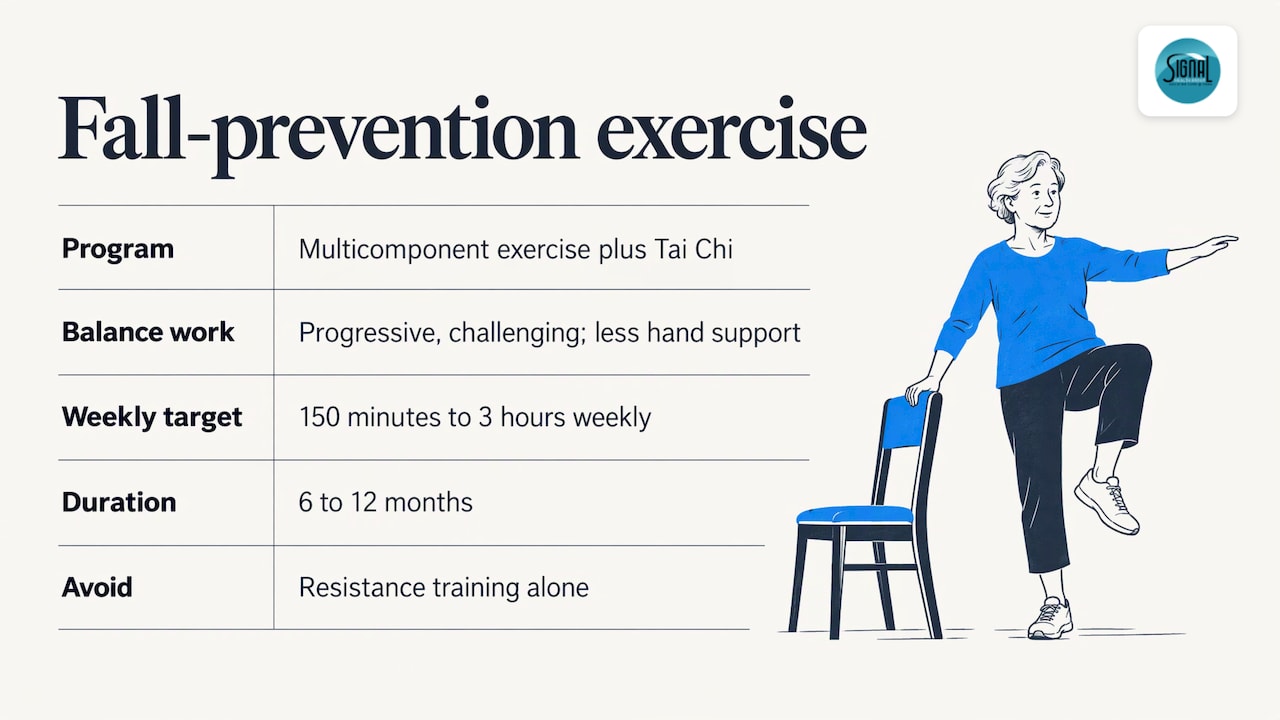
In practice, that is why a good home program is not a sheet of leg lifts. It combines strength, standing balance and walking practice, and it gets harder as you improve. Because it runs for months, it needs somebody at home to keep it on track.
Who qualifies for Medicare-covered home physical therapy
Medicare's rules are the starting point for most seniors. According to Medicare's "Medicare and Home Health Care" booklet (July 2025), you qualify when all of the following are true:
- You are under the care of a doctor or other allowed provider, and your care plan is reviewed regularly.
- That provider certifies you need physical therapy (or intermittent skilled nursing, speech-language pathology, or continued occupational therapy).
- You are certified as homebound.
- A Medicare-certified home health agency provides the care.
- You had a face-to-face visit with your provider within the required timeframe.
The same booklet defines homebound as normally being unable to leave home, or needing a lot of effort to do so, because of an illness or injury. You can still go to medical appointments, and short or infrequent outings do not disqualify you. Attending adult day care or religious services is also allowed.
Therapy must also be reasonable and necessary. In Medicare's terms (getting-started booklet, August 2025), that means a specific, safe and effective treatment, complex enough that it needs a qualified therapist or therapist supervision, with a reasonable amount, frequency and duration. This is the same logic Medicare applies to other services; for a sense of how it handles medical necessity elsewhere, see how Medicare covers lab tests.
A worked example
Say your mother, 79, comes home after a hip fracture repair. Walking to the bathroom takes a walker and a lot of effort, and she leaves the house only for follow-up appointments. Her surgeon or primary care doctor certifies that she needs physical therapy and is homebound, and a Medicare-certified agency is chosen. The agency evaluates her, writes the plan with her doctor, and schedules visits. Under Medicare, she pays nothing for those covered home health services, though she would owe 20% of the Medicare-approved amount for covered medical equipment after the Part B deductible, as Medicare states.
How often and for how long
Medicare allows unlimited home health visits if you are eligible. "Part-time or intermittent" care generally means up to 8 hours a day combined for skilled nursing and aide care, up to 28 hours a week, or up to 35 hours a week for a short period if your provider decides it is needed, according to Medicare. Therapy itself must be reasonable in frequency and duration, and your plan should carry measurable goals. CMS guidance on care planning also says plans must state the amount, duration and scope of services and be reassessed when your circumstances change.
In plain terms: expect several visits a week at first, tapering as you gain independence, with your home exercise routine carrying the work in between.
Home versus outpatient therapy
Outpatient clinics suit people who can travel comfortably and want access to larger equipment. Home therapy suits people for whom the trip is the barrier, and people whose goal is functioning in one particular house.
| Home physical therapy | Outpatient clinic | |
|---|---|---|
| Where | Your home | Clinic or hospital |
| Medicare eligibility | Homebound, doctor-certified, certified agency | Medically necessary therapy, no homebound rule |
| What you pay under Medicare | Nothing for covered home health services | After the Part B deductible, 20% of the Medicare-approved amount |
| Best for | Limited mobility, post-surgery recovery, fall risk in your own layout | Mobile patients who can travel easily |
| Home safety review | Built in | Not part of the visit |
Medicare puts no limit on what it pays for medically necessary outpatient therapy in a calendar year, per its physical therapy coverage page.
Medicaid, the VA and other ways to pay
Medicaid
Medicaid home health is mandatory for states, and states may include physical therapy in the benefit, according to CMS. Rules vary widely by state. Ohio's state plan amendment effective November 2021, for example, allows home physical therapy for any beneficiary with a medical need, when ordered by a physician or allowed practitioner and reviewed at least every 60 days. Virginia's Medicaid home health chapter, revised in August 2024, covers in-residence therapy when ordered, complex enough to need a licensed therapist, and expected to improve the condition in a reasonable time. If you are low-income, your state Medicaid office confirms what applies where you live.
Veterans
According to the VA, all enrolled Veterans are eligible for skilled home health care, including physical therapy visits, if they are eligible for community care and meet clinical criteria. The care is delivered by a community home health agency under VA contract, and copays are determined through VA Form 10-10EC. For modifications, the VA's HISA program provides a limited lifetime grant for medically necessary changes such as ramps, widened doorways, roll-in showers and handrails, under VHA Directive 1173.14. The VA's brochure lists the one-time limit as $1,200 for non-service-connected patients and $4,100 for service-connected patients, depending on rating. For the wider picture on veteran benefits, our guide to veteran home care benefits walks through what the VA covers and how to apply.
Getting your home ready
The VA's guide describes modifications on a ladder: low-tech changes first, then adaptive equipment, then structural work, with follow-up to confirm the changes work. Before the first visit:
- Clear a walking path from bed to bathroom and remove loose rugs or secure them.
- Add motion-activated or night lighting along that path.
- Gather medication lists, discharge papers and the doctor's contact details.
- Wear loose clothing and supportive shoes you would actually wear at home.
- Have a family member or caregiver present so they learn the exercises and transfer techniques.
- Keep a chair with arms nearby for rest breaks and exercises.
If you take medicines that make you dizzy, or you have heart or breathing conditions, tell the therapist at the start so exercise intensity is set safely. Your doctor remains the person to ask about any exercise limits.
Why the care around the therapy matters
Therapy visits last under an hour. The other 160-plus hours of the week are where the plan succeeds or stalls: remembering exercises, getting from room to room safely, bathing, dressing and eating well while strength returns. A single provider that can pair home health with day-to-day personal care keeps those hours covered, so the therapist's gains are not lost. Our guide to caring for elderly parents at home lays out how families can organize that daily support, and the signs a loved one needs in-home care can help you decide when to act.
How we can help
Hahn March founded Signal Health Group Franchise, a nationwide network since 2012 that provides senior care, home health, personal care and hospice services, with a focus on seniors, veterans, people with disabilities and low-income families in underserved communities. Care is tailored to each person, with support for independence and quality of life. If you are arranging care after surgery, a fall or a decline in mobility, start with our home health and personal care services.

For families whose needs may later extend to end-of-life care, our network also provides hospice, and our explainer on Medicare hospice coverage covers what Part A pays for.
FAQ
Can a physical therapist come to my house?
Yes. Through a home health agency, a licensed therapist can visit and treat you at home. Under Medicare you need a doctor's certification that you need therapy and are homebound, and the agency must be Medicare-certified.
Does Medicare pay for physical therapy at home?
Medicare pays for covered home health services, including physical therapy, with no cost to you for the services, according to Medicare. You pay 20% of the approved amount for covered medical equipment after the Part B deductible.
What does "homebound" mean?
It means leaving home normally takes a lot of effort or is not possible because of illness or injury. Medical appointments, short outings, adult day care and religious services do not disqualify you, per Medicare's booklet.
What should I wear and have ready for the first visit?
Wear loose, comfortable clothes and supportive shoes. Have your medication list, discharge papers and a clear walking path ready, and ask a family member to be there so they learn the routine.
Sources
- Medicare: Home Health Services Coverage
- Medicare's Home Health Benefit (August 2025)
- Medicare and Home Health Care (July 2025)
- Medicare: Physical Therapy Coverage
- APTA-Geriatrics guideline on physical therapy management of fall risk
- CMS: Home and Community-Based Services care plan requirements
- Ohio Medicaid SPA 21-0029
- Virginia Medicaid Home Health chapter (August 2024)
- VA: Skilled Home Health Care
- VHA Directive 1173.14 (HISA)
- VA Prosthetics: What to Expect brochure
- VA Home Assessments and Modifications Guide